
Landing Page for WhatsApp Sellers in Malaysia — No Website Needed
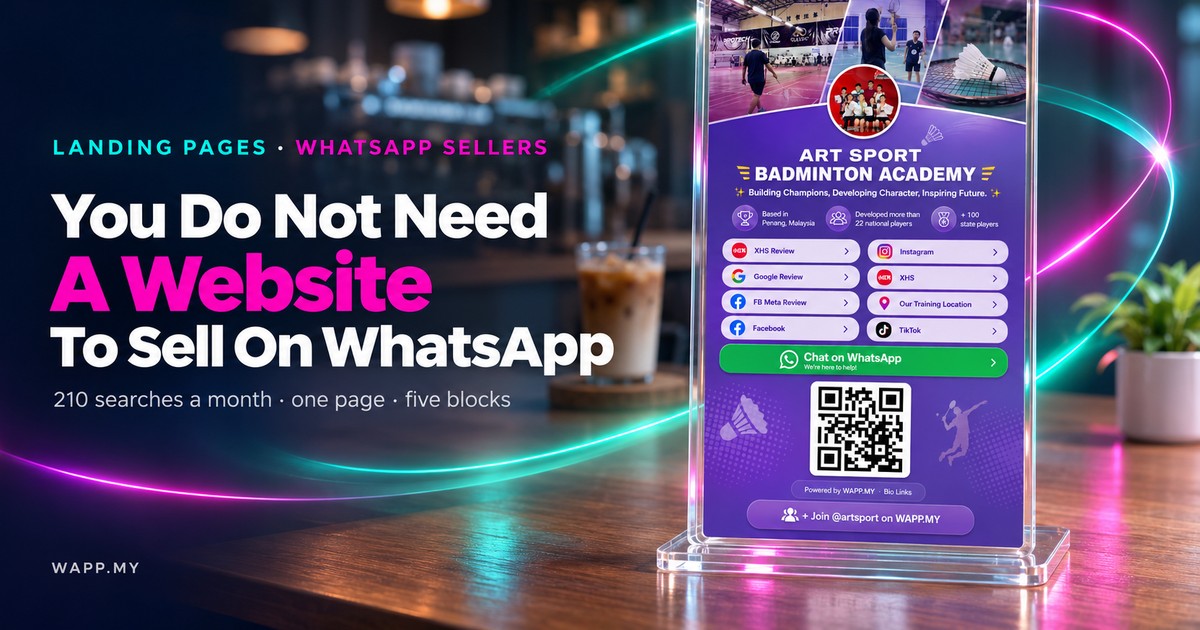
Most Malaysian sellers who ask about a website do not need a website. They need one page that answers three questions in under ten seconds: what do you sell, how much, and how do I order. Everything else is somewhere for a customer to get lost.
This guide is the one-page structure, the ten-minute build, and the number to watch afterwards. It assumes you sell through WhatsApp, which most small sellers in Malaysia do.
Why a six-page website loses to one page
A website is built for someone who arrives with intent and patience. It offers an About page, a Services page, a Gallery, a Blog, and a Contact form, and it expects the visitor to navigate.
Your customer arrives from a WhatsApp status or a Facebook group, on a phone, with one thumb, and about fifteen seconds of patience. Every additional page is a decision they have to make. Every decision is a chance to leave.
A landing page removes the decisions. There is one screen, one price, one button. The customer either taps it or they do not, and you learn which in a single number.
There is also a practical argument. A six-page website needs hosting, a theme, a plugin update cycle, and someone to fix it when the contact form stops sending email. A single page needs none of that, and it can be edited from a phone between orders.
The five blocks every selling page needs
1. A headline that names the thing and the buyer
Not "Welcome to our store". Something like "Customised gift boxes for KL offices, from RM45". It tells the customer what it is, who it is for, and roughly what it costs, in one line.
2. Proof, immediately below the headline
Three photos of real work, or two customer messages, or the number of orders you have shipped. This is the block most sellers skip and it is the one that decides whether a stranger trusts you.
3. Price, or a price range
Hiding pricing feels safer and usually backfires. A range filters out the customers who were never going to buy and saves you both a conversation. "From RM45" is enough.
4. One primary action
One WhatsApp button, repeated. Not a form, not an email address, not a phone number to copy. The button should open a chat with the message already written, so the customer only has to tap send.
5. The detail that removes the last objection
Delivery area, lead time, or payment methods. Pick the one question you answer most often in chat and put it on the page. It is usually "do you deliver to my area".
Building it in ten minutes
Write the five blocks in a note first. Do not open a tool until the words exist, because the tool will tempt you into choosing a template before you know what you are saying.
Then create the page. In WAPP.MY, a Bio Links page gives you a headline, a bio line, a photo, and a list of links, with one WhatsApp button that opens the chat directly. The page lives at a single short URL you can put anywhere.
Order the links deliberately. The order should match the order of the questions a customer asks: what is it, how much, can I see more, how do I order. Put the most important link first, because most visitors never scroll.
Then set the background and text colours once. If the text is hard to read in sunlight, you have lost the customer standing outside your shop.
Getting traffic without spending money
You already have places to put the link. Use them before considering ads.
- WhatsApp status — the highest-intent placement you own, and it costs nothing.
- Facebook groups — the local buy and sell groups still work in Malaysia, if you post as a person rather than a page.
- Instagram and TikTok bio — one link, not five.
- A QR code on packaging — every parcel becomes a re-order channel.
- Your reply template — the first message you send to a new enquiry should contain the page link.
Paid traffic comes last, and only after the page converts organic traffic. Paying to send people to a page that does not convert is the most expensive way to learn nothing.
Measuring it without fooling yourself
Two numbers matter: page views, and chats started. The ratio between them is the only honest measure of whether the page works.
If 200 people opened the page and three started a chat, the page is the problem. Look at the headline, the price, and the proof. If 200 opened and 40 started a chat, the page is fine and the next question is whether those chats close.
Three cautions, because this is where sellers misread their own data.
Views include your own visits. When you open the page to check it, that is a view. Industry analytics tools count it too.
Link previews count as clicks. When you paste your link into a group, the platform may fetch it to build a preview card. That is traffic that never became a person.
Chats started is not orders. A tap that opens WhatsApp with a pre-filled message still requires the customer to press send. Expect a drop between the two, and treat that drop as a conversation-quality problem rather than a page problem.
When you actually do need a real website
A single page stops being the right tool in three situations, and not before.
You need to be found in search. One page can rank for one topic. If you sell forty products that people search for by name, you need pages that can each rank.
You need checkout without a conversation. Some customers will not message to buy. If volume is high enough that the chat step is the bottleneck, you need a cart.
Stock changes faster than you can edit. A hundred SKUs with daily price and availability changes belongs in a proper store, not in a page you edit by hand.
Until one of those is true, a landing page is not the cheap version of a website. It is the correct version of the tool for the job.
The order to do it in
Today: write the five blocks and create the page. Tomorrow: put the link in WhatsApp status, both social bios, and your reply template. In a week: compare views to chats and change the one block that is weakest, usually the headline or the price.
That is the whole loop. It takes ten minutes to start and one number to judge.