
What Is a Short Link? Short URL Meaning, Redirects and Click Tracking Explained
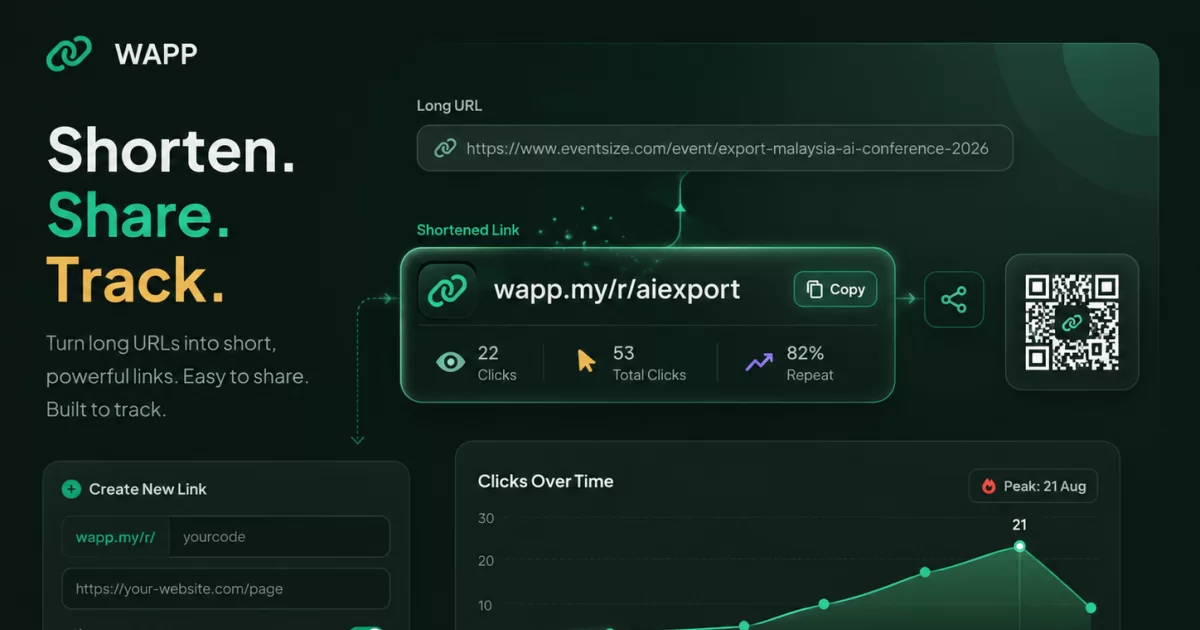
You have already seen a short link today. A friend drops wapp.my/r/yourbrand into a WhatsApp group; a sticker on a parcel says the same thing. You tap it and land on a Shopee store, a Google Form, a menu — something far longer than what you tapped. That is a short link. This article explains what it is, how the redirect works, what you can measure, when it is the wrong choice, and whether short links are safe.
What Is a Short Link? A Plain Definition
A short link — also called a short URL or a shortened link — is a compact web address that sends the visitor somewhere else. It is not a copy of the destination and not a preview of it. It is a forwarding address.
wapp.my/r/yourbrand → https://shopee.com.my/Your-Brand-Official-Store?categoryId=100012&entryPoint=ShopByPDP&from=search
Both open the same store, but only the first can be read aloud, typed from a printed card, or squeezed into an Instagram bio without being cut off.
- A short link does not store your page. Your content stays exactly where it is. Nothing is copied or mirrored — the link only holds the instruction "send visitors here".
- A short link is not a URL shortener. The shortener is the tool; the short link is one address that tool produces. A single shortener can make thousands of them.
How the Mechanism Actually Works
There is no mystery under the hood — just one extra round trip:
- The browser requests the short URL from the server hosting wapp.my.
- The service looks up the code. yourbrand is a database key; the matching value is your long destination plus that link's saved settings.
- The service answers with a redirect — not a page, but a small instruction that says where the real address is.
- The browser follows it and renders the destination page. To the visitor, the whole hop feels like one tap.
301 vs 302, in plain language
- 301 — permanent. "This address moved here for good." Browsers may remember and stop asking — which means the service is never asked again, and never counts the click.
- 302 — temporary. "For now, go here." The browser asks every time, so every request is a chance to record a click, a device, a country and a referrer.
That is why most shorteners, WAPP.MY included, answer with a temporary redirect: it is the only way the analytics stay accurate.
The destination is not hidden from the visitor
A short link hides the destination from someone reading the message before they click. That is the format's honest downside, and the safety section below deals with it properly.
It hides nothing from the person who does click. The redirect is not a secret tunnel: once the hop completes, the real address sits in the browser's address bar with its full domain and path. A long-press or hover reveals it before you commit, and chat apps often render a preview card with the destination site's title and image.
Anatomy of a Short Link: Domain and Code
Every short link is only two pieces: wapp.my (the domain) and /r/yourbrand (the path, the family marker, and the code).
The domain is what people recognise — the reason a link on a familiar domain gets clicked while one from an unknown shortener is ignored. The code is the final segment identifying your destination out of millions of others.
Custom alias vs random code
- A random code is generated for you. Fast, guaranteed unique and completely meaningless — fine when a link will only ever be clicked, never read.
- A custom alias is chosen by you: wapp.my/r/kedai-kopi instead of a scrambled string. It says who you are, survives being read aloud, and still makes sense if a chat app swallows part of it.
A custom alias costs fifteen seconds of thinking and pays you back every time somebody types the address instead of tapping it.
The alias rules, before you try
Short codes must survive being typed and parsed, so the rules are strict. On WAPP.MY a custom alias must be 6 to 30 characters long, may contain lowercase letters a to z, digits and hyphens only, and cannot start or end with a hyphen — kedai-kopi is valid, -kedai-kopi- is not. Aliases must be unique, and a small set of words is reserved by the platform.
One note: the short link feature is labelled BETA in the member app — the tool works, and new analytics views keep arriving.
Why Businesses Use Short Links
Short links began as a character-limit workaround. That is no longer the main reason anybody uses one.
- Readability in a chat. A link pasted into a WhatsApp group should look like a business, not like a tracking artifact.
- Character limits. Bios, SMS and print layouts have hard caps. A short link fits; a raw checkout URL does not.
- Print and QR. Cards, packaging, receipts and stickers all carry an address somebody might have to type.
- Consistent branding. Every link carries the same domain, so a customer who has seen you once recognises you again.
- Flexibility after printing. A QR code pointing at a short link can be re-aimed without reprinting anything.
- Click tracking. A raw URL tells you nothing. Routed through a short link, every click becomes a data point — the reason serious marketers bother at all.
What You Can and Cannot Measure
What you can see: total clicks; unique visitors de-duplicated by IP address; repeat visitor rate; device; browser; operating system; country; UTM source; referrer; and a last-7-days trend.
What you cannot see — the honest part:
- Country is the only geographic dimension. There is no city, state or region breakdown. If you genuinely need Penang versus Johor, build separate links and compare them.
- Unique visitors are counted by IP. An office, campus or mall behind one shared connection looks like fewer people than it really is.
- No names, phone numbers or email addresses. A click is not a lead. Analytics tell you what happened, never who did it.
- Nothing on the destination page. The short link counts the click and hands the visitor over; what happens next is your website's job.
If campaign data also needs to reach your website analytics, that is what UTM parameters are for — see the guide to tracking campaigns with UTM and short links.
Are Short Links Safe? An Honest Answer
Short links are a known phishing vector. The entire appeal of a short link is that the visible text is short and readable, which is exactly why a reader cannot tell whether it points at a bank login page or a convincing fake. A shortened link in an unexpected message is one of the oldest tricks online, and it works because the format is compact and opaque.
The risk is manageable with a short, boring checklist.
Before you click:
- Did you expect it? Surprise is the attack, not the URL.
- Do you trust the sender — and is it really them? Compromised accounts message the whole contact list, so a familiar name is not proof.
- Preview the destination. Hover, long-press, or let the chat app render its preview card. If the destination has nothing to do with the sender or the topic, stop.
- Distrust urgency. "Closes in 24 hours" and "claim before midnight" exist to stop you checking.
- Never enter a password after clicking a shortened link you did not ask for. Navigate to the site yourself.
Before you shorten: say plainly what the link goes to when the audience has never heard from you, and use a shortener domain they can look up and recognise.
When NOT to Use a Short Link
- When the destination is already short. Shortening wapp.my/shop into wapp.my/r/shop adds a hop and removes nothing.
- When the full URL builds more trust than brevity would. Invoices, payment pages and login links should show the real address — customers expect it, and a hidden destination on a sensitive link reads as a red flag.
- When the platform already previews the link. If the chat app or email client already shows the destination's title and image, a short link adds a hop without adding clarity.
Short Link vs Domain vs QR Code
These three get mixed up constantly, and the confusion causes real mistakes — like printing a QR code that points at a page you can no longer change.
- A short link is a redirect. It is an address that forwards to another address, so a long destination has a short, trackable front door. You can re-aim it, pause it, and read its clicks.
- A domain is an identity. yourbrand.com is the name your business owns and renews, and where your website actually lives — not a redirect, and the one thing you should never let expire.
- A QR code is a printed container. It is a picture of an address so a phone camera can read it. Once two thousand boxes are printed, the only thing you can still change is what that address points to — which is why a QR code should point at a short link, never at a final page.
If you are planning a print run, the QR code and short link guide for Malaysian businesses walks through that choice, and the WhatsApp link tool covers the chat-opening variant.
A Very Short History of the Short Link
Short links arrived in the TinyURL era, when early services worked out that a long address could be swapped for a short code that simply forwards. They stayed niche until character-limited social platforms made brevity compulsory, which pushed shorteners into daily use and turned click counting into a mainstream marketing habit. Since then the emphasis has shifted from shorter links, to measurable links, and lately to shortening on a domain the sender owns.
Ready to Try One?
That is the whole concept: a short address that forwards to a long one, resolved by a lookup and answered with a temporary redirect, wrapped in a dashboard that counts what happened.
To see one working, the WAPP.MY short link tool creates links like wapp.my/r/yourbrand with a custom alias, click analytics, UTM tracking and a free QR code download — free, with no ads. The free URL shortener Malaysia guide covers what the free plan includes, and the step-by-step guide to creating your first short link takes about thirty seconds. If the link should open a conversation instead of a page, compare the two formats in short link vs WhatsApp link. A short link also pairs well with a Bio Links page or a digital vCard, so a single tap can offer a menu, your reviews and your contact details together.
Ready to Get Started?
Create your free account in 30 seconds. No credit card needed.
✨ Create Your Free Account