
Digital Business Card in Malaysia — What Free Actually Gets You
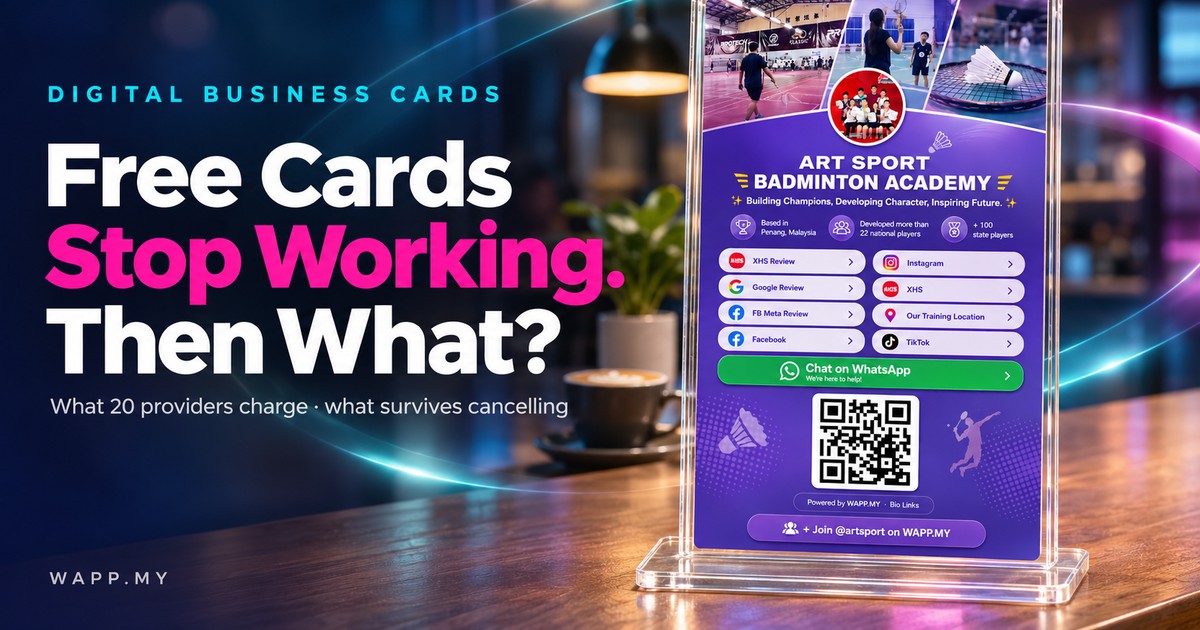
Search for a digital business card in Malaysia and you will find twenty providers, all claiming to be free, none showing a price table on the same page. This article is the table they avoid, plus the one question almost nobody answers: what happens to your card the month you stop paying.
Prices were checked in November 2026 and are stated in ringgit where the provider bills in ringgit, and in US dollars where it does not, because that is how the charges actually arrive on a Malaysian card statement.
What a digital business card actually has to do
Strip away the feature lists and three jobs remain. If a tool does these three well, it is good enough.
1. Get your details into the other person phone, correctly. Name spelled right, number with the right country code, email typed without a typo. This is the entire point. Everything else is decoration.
2. Give them one obvious next step. A WhatsApp button, a booking link, or a catalogue. A card that only shows information makes the other person do the work.
3. Still work in a year. Printed QR codes, screenshots in chat threads, and links inside email signatures all outlive the moment you shared them. If the card breaks, every one of those breaks with it.
The comparison, with the awkward columns included
| Factor | Free tier | Typical paid plan |
|---|---|---|
| Cost | RM0 | RM15 to RM60 per month, billed yearly |
| Card link | Provider subdomain | Provider subdomain, custom domain on higher plans |
| Analytics | Usually none | Views, clicks, sometimes scan source |
| Staff cards | One per account | Bundled seats, or charged per user |
| Lead capture | Rarely | Common, usually a form or a WhatsApp handoff |
| Provider branding | Usually visible | Hidden on paid plans |
| What happens when you stop | It keeps working, limited | Downgrade, hidden card, or released link |
Two notes on that last row, because it is the one that costs people money.
Downgrade. Your card stays online but reverts to the free limits: branding appears, analytics disappear, extra cards deactivate.
Released link. This is the dangerous one. If your card lived at provider.com/yourname and you cancel, some providers release that path. Anyone, including a competitor, can claim it. Every QR code you printed now points at their card.
That is not a hypothetical. It is why we recommend putting a printed QR on a link you control rather than on a path you rent.
The cost nobody counts: reprinting
If your card is printed on a tap card, a standee, a van, or a shop window, changing your card link means reprinting all of it. Budget for that before choosing a provider, because it dwarfs the monthly fee.
There is a way around it. Point the printed QR at a short link you control, and have that short link forward to whatever card you use this year. When you change providers, you change the destination and keep every printed code working.
In WAPP.MY this is one field: the short link target can be edited later, and the QR PNG you already printed keeps resolving. The custom alias must be 6 to 30 characters, lowercase letters, numbers and hyphens.
vCard file or card link? Pick deliberately
These get confused constantly, and the choice matters more than the provider.
| vCard file (.vcf) | Card link | |
|---|---|---|
| Saves into phone contacts | Yes | Only if the receiver taps save |
| Works with no data | Yes, once downloaded | No |
| Can be updated later | No | Yes |
| Carries links, catalogue, review | Limited | Yes |
| Measurable | No | Yes |
For a sales meeting where the goal is a saved contact, send the vCard. For a networking event where the goal is a follow-up, send the link. Most professionals should have both, generated from the same profile.
Making one in three minutes
Decide the one action first, before you open any tool. If the answer is "they should WhatsApp me", your card needs a WhatsApp button and little else. If the answer is "they should see my menu", it needs the menu link above the fold.
Then fill four fields: name, role with the company name spelled out, phone in international format, and the one link. Add a photo only if the card is used in a context where people need to recognise you.
Finally, test the card on a phone that is not yours, on mobile data rather than office wifi. Half the broken cards we see look fine on a laptop and collapse on a phone, which is where every scan happens.
Five questions to ask any provider
- What exactly happens to my link if I cancel? Get it in writing. If they will not say, assume the worst.
- Is the card path mine or theirs? A custom domain is the only real ownership.
- Do you charge per seat, and what counts as a seat? A ten-person team on per-seat pricing is a very different number.
- Can I export my contacts and analytics? If not, you are renting your own pipeline.
- Does the free tier show your branding? Ours does. We would rather say that than pretend otherwise.
On the last point, being honest about it: the free version of WAPP.MY carries WAPP branding and shows no ads. If removing the branding matters to your brand, that is what a paid plan is for, and any provider telling you otherwise is selling you something else.
What we recommend for a Malaysian small business
Start free. Make one card, share it twenty times in a week, and watch whether anyone actually taps the action you chose. Most people discover their card is fine and their call to action was wrong.
Pay only when one of three things becomes true: you need more than one card for staff, you need to know how many people opened it, or you need the printed QR to keep working after you change tools. Those are real needs. Everything else is a feature list.